
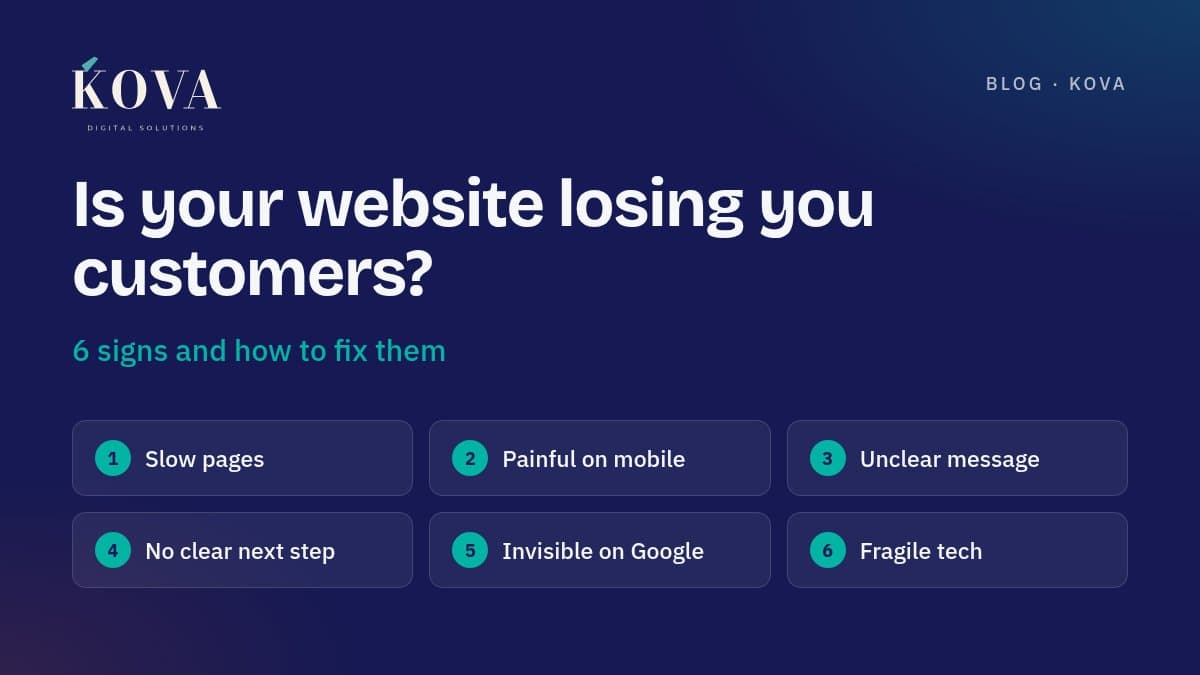
Is your website losing you customers? 6 signs and how to fix them
Slow pages, an unclear message, no obvious next step, invisible on Google… Six signs your website is holding your business back, with a quick check for each and how we fix it.
A website can be live, look good, and still drive customers away without anyone noticing. Visitors don't complain: they close the tab and go somewhere else.
Whether you run a local shop or a company with several teams, the same signs keep coming up. Here are the six most common, with a quick check for each, what they cost you, and how we fix them.
1. Slow pages, especially on mobile
Quick check. Open your site on your phone, on 4G, without wifi. How long before you can read and tap? You can also run the address through PageSpeed Insights, Google's free tool.
Why it costs you customers. People in a hurry don't wait. If the page stays blank, they go back and pick the next result.
How we fix it.
- Compressed images, served in the right format (WebP, AVIF) and at the right size for each screen.
- A modern framework that only loads what each page needs.
- Fewer third-party scripts (widgets, trackers) slowing things down.
- Fonts and videos loaded without blocking the page.
2. A painful mobile experience
Quick check. On your phone, complete the main action on your site: book, request a quote, buy. Do you have to zoom, aim for tiny buttons or scroll sideways?
Why it costs you customers. A large share of visits happen on phones. If the main action is painful there, those visitors give up before the end.
How we fix it.
- Mobile-first design: we start from the small screen, then scale up.
- Thumb-sized buttons, short forms and the right input types (a number keypad for phone numbers, for example).
- Testing on real phones, not only in a desktop browser.
3. An unclear message
Quick check. Show your homepage for five seconds to someone who doesn't know you. Can they say what you do, who it's for, and where?
Why it costs you customers. If visitors have to guess, they don't guess for long. A vague slogan or a page full of jargon gives them no reason to stay.
How we fix it.
- A headline that says clearly what you do and who it's for.
- A concrete supporting line, then proof: work, references, real photos.
- A simple visual hierarchy, so the eye knows where to go.
4. No clear next step
Quick check. On every important page, look for the button that moves things forward: book, call, get a quote. Then send yourself a message through your own form. Does it arrive?
Why it costs you customers. An interested visitor who can't find how to reach you — or whose message never arrives — is a lost customer, and you never find out.
How we fix it.
- One main call to action, the same everywhere, visible without searching.
- Short, tested forms with a clear confirmation message.
- Direct alternatives where they help: phone, WhatsApp, email.
5. Invisible on Google
Quick check. Search Google for what you do and your city, without typing your name. Do you show up? Do the title and description make people want to click?
Why it costs you customers. People who don't know you yet search for a need, not a name. If Google doesn't understand your site, they find your competitors.
How we fix it.
- A title and description specific to each page.
- Structured data (schema.org) so Google understands who you are, where you are and what you offer.
- A sitemap, well-linked pages and, where needed, declared language versions.
- A Google Business Profile that matches the website.
6. Hard to update, or fragile
Quick check. How long does it take to change opening hours, a price or a photo? Has your site ever broken after a plugin update? Do you know who to call if it happens?
Why it costs you customers. A site nobody dares to touch ends up showing wrong information. And a site that's down, even for a few hours, sends your visitors somewhere else.
How we fix it.
- A modern, maintainable stack with as few dependencies as possible.
- Content kept separate from code, so everyday updates stay simple.
- Regular updates and uptime monitoring, so you hear about problems before your customers do.
- Version-controlled, documented code that any developer can pick up.
A concrete example
To see these principles applied to a specific case, read our article on the restaurant website template: online booking, a readable menu, reliable practical info and mobile first.
Build or rescue
Starting from scratch? We build a site that avoids these six traps from day one. Already have a site? We start with a diagnostic: we find what's holding it back, fix it in order of impact, then make it stable.
Either way, you get a clear quote before work begins, and one point of contact from start to finish.
Blog
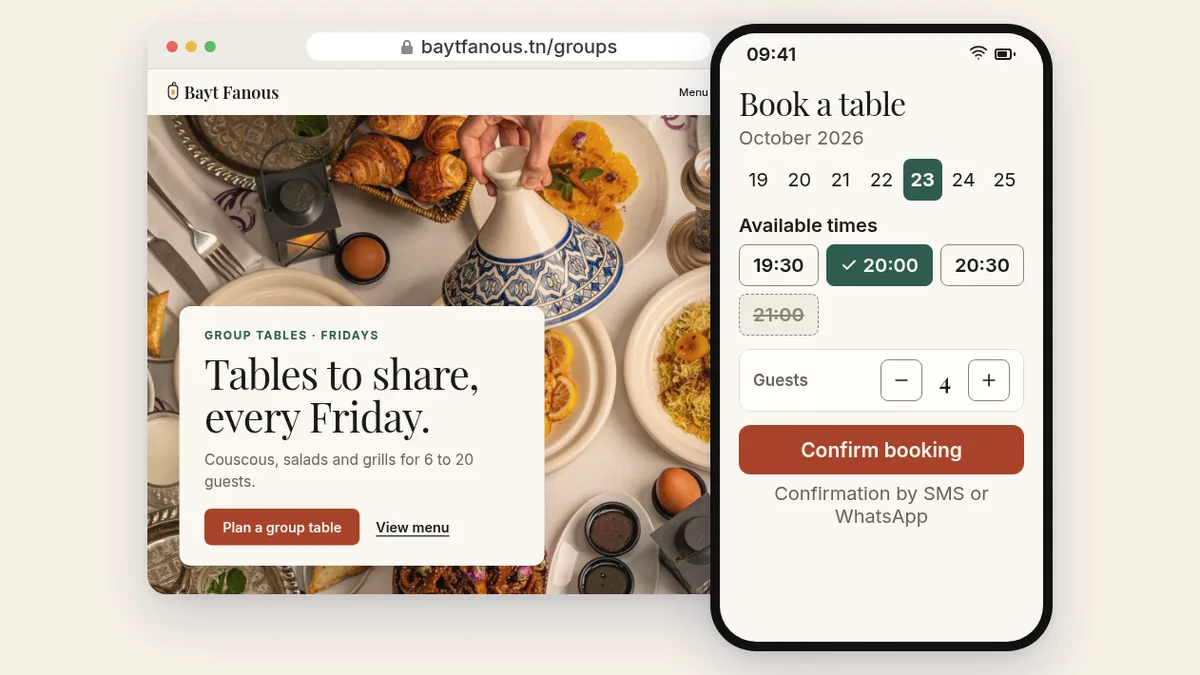
A restaurant website that takes bookings
Missed calls during service, bookings lost in DMs, a menu nobody can read: how our restaurant website template answers each problem.
Read the article